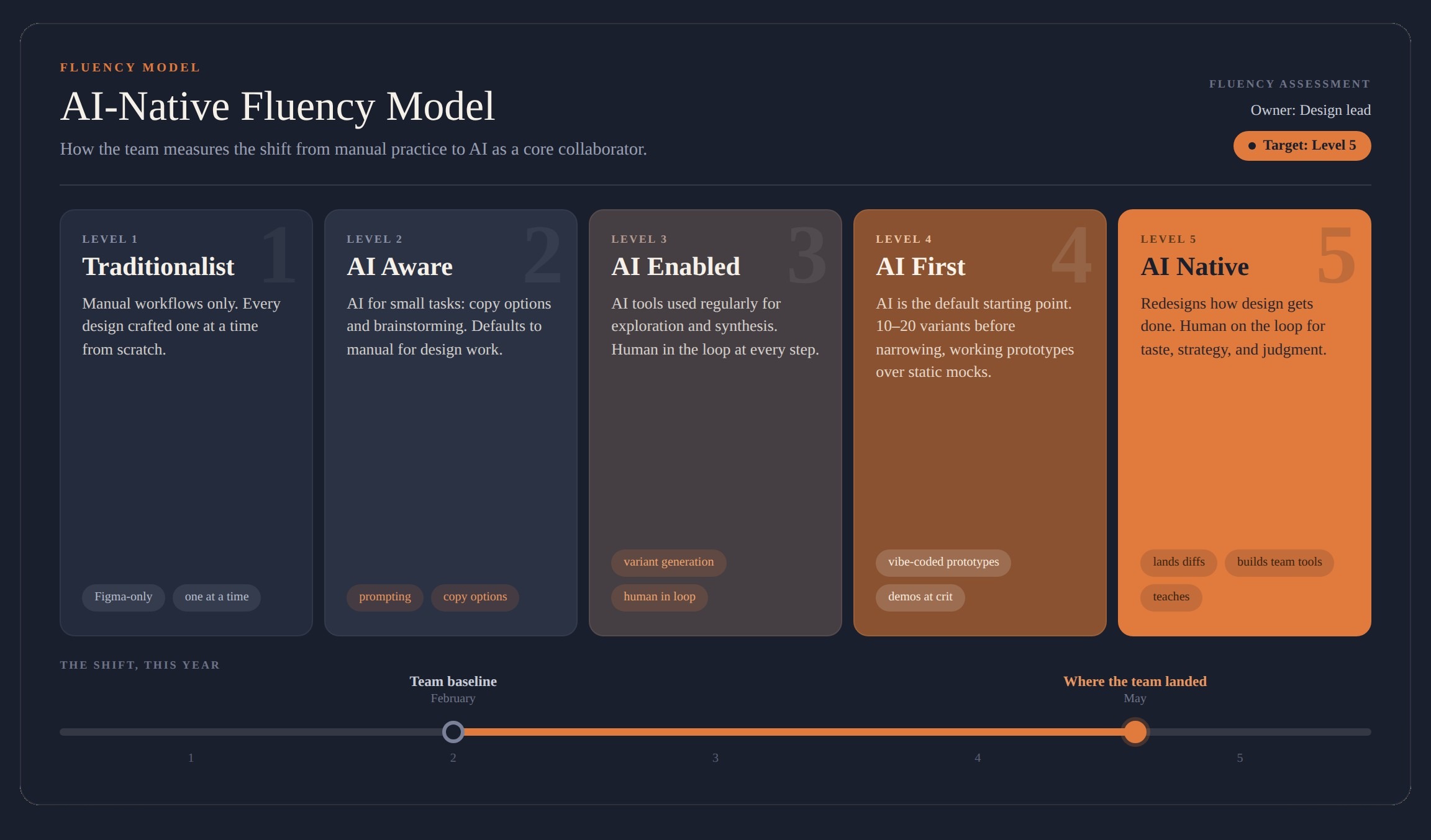
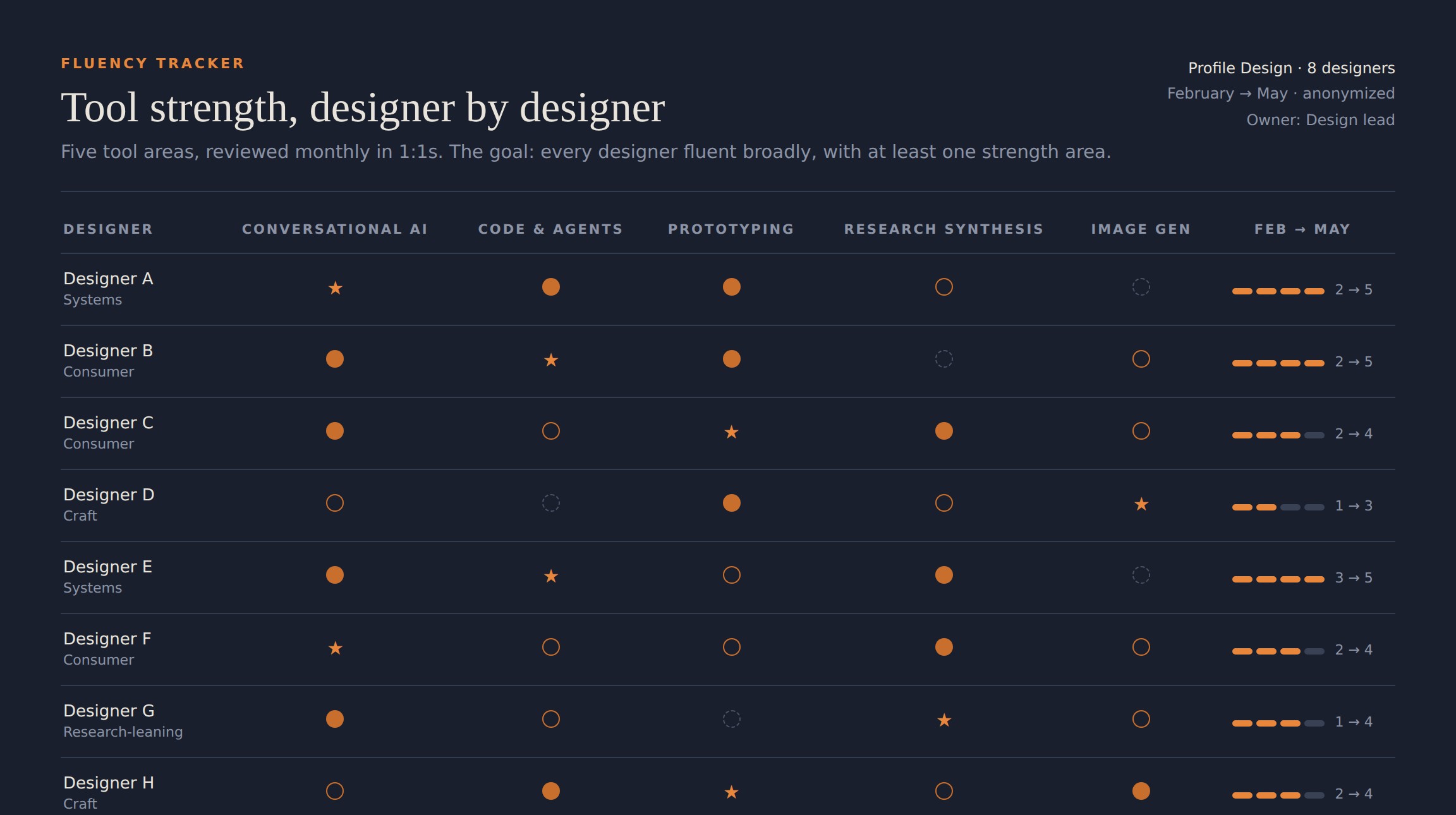
When leadership told every team to become AI-native, most stalled. I built the operating model that got mine there: the right AI at each point of the design cycle, taught across the discipline and made to stick. My team reached AI-native fluency a month before the deadline, and the model spread beyond our org.

The brief
Design leadership set a clear expectation: every team would work in an AI-native way. My org, Profile, was AI-aware, not AI-native, like most of the company. The mandate was real. The method was missing.
What was actually happening was three disciplines each reaching for AI on their own. Product managers were mocking up screens in Figma. Engineers were designing in Cursor. Designers were trying to ship and land code changes. Everyone was moving, in good faith, but none of it connected, and the roles blurred instead of sharpening. The result was that AI was generating more work than it saved.
The tools already in play across the org, before any shared model.
The reframe
Being AI-native was never going to mean everyone doing everything with AI. It meant a shared operating model that put AI where it actually made the work better, at each part of the product-design cycle, and connected the disciplines instead of blurring them.
I built that model in partnership with my engineering director, so it held across design, engineering, and product rather than living in one function. Instead of a PM mocking up screens in Figma and an engineer designing in Cursor, each stage of the cycle had a clear owner, with design's judgment in the room at every step: synthesis and research with product, exploration and variants with PM, prototyping and shipping with engineering, all with AI.
Before: three silos
Disconnected. More work, not less.
After: one connected cycle
Connected. Design judgment at every step.
The operating model
The model gave every discipline a shared way to work, and it rested on four principles I published for the team.
When the cost of trying drops from weeks to a day, the bar becomes conviction: show the working thing.
Reserve real time to explore. The fastest path to the goal is often one you haven't found yet, and only tinkering finds it.
Tinkering earns its place by accelerating the work that has to ship.
AI makes both good and bad taste louder, so product sense and craft matter more now.
With the model in place, the work itself changed. Static Figma files became working prototypes. Decks became live demos. Design and engineering stopped working in sequence and started working together, and designers began shipping real code.
The rollout
Adoption couldn’t come by mandate; it came person by person, matched to where each designer actually was. Someone who found dev tools intimidating got a friendlier setup and a peer to pair with for a first code change. Someone already comfortable got pushed to codify their workflow into something the whole team could use. The through-line was hands-on: a “ship your first change” help desk moved the team more than any number of posts.
The hardest part was not technical. AI adoption brought many layers of anxiety: adopting new tools, increasing output, and holding the bar for quality and human creativity. I named it directly and reframed the work: AI amplifies your judgment; the effort is still yours. And I demoed my own setup in one-on-ones, which shifted the framing from a tool people were told to use to one they actually wanted.
The mandate was bigger than Profile, so I was one of a small group asked to lead AI-native adoption for design managers across Facebook. I published playbooks, ran sessions and manager circles, and shared every process, tool, and agent I built with my manager and director peers, so the discipline matured together instead of each org solving the same problem alone.
I built the fluency model once and taught it across the org, so design moved faster than team-by-team adoption could.
The outcome
The February training moved one or two designers, then adoption stalled for six weeks. The playbook changed the slope: within six weeks of publishing it, most of the team worked at AI-native fluency and every designer had shipped production code. The team built AI agents that took real quality work, bug-fixing and accessibility remediation, from hours to minutes. And the model traveled: it was adopted beyond Profile, the outcome I cared about most.
One more thing
I split my own assistant into five specialized agents on a shared, always-on workspace. Each owns a lane and runs its own scheduled jobs in the background, so my workspace is already caught up the moment I open it, even mid-meeting. Claud-Scan keeps an eye on my incoming chats, emails, and meeting notes, plus recent leadership posts and published research, and routes it to the specialists. They report up to Claudia, my primary agent, who manages the rest of the team, reconciles their work, and is the one I go back and forth with directly.
Claudio is the one I lean on most. It stays on the lookout for what’s top of mind for leadership, interesting signals in research, and unsolved problems, and proposes them to me. I say go, and it runs design loops until it has ready-to-go prototypes.
What it gives me
None of it replaces my judgment or design taste; it clears the busywork so I can put more of myself into the parts that need me: my team, and the thinking.